Custom Children's Toys vs. Custom Craft Gifts & Stationery: A Head-to-Head Decision
Custom Children's Toys vs. Custom Craft Gifts & Stationery: A Head-to-Head Decision

Cover image: a customizable children's craft toy kit from the AHA-CT Series — the product path that carries age grading and toy-safety documentation.
Two custom gift paths share a factory floor but not a rulebook. Custom children's toys inherit toy-safety obligations, age grading and child-directed artwork review; custom craft gifts and stationery are governed mainly by material, print and packaging specifications. This head-to-head sets out where the requirements, cost drivers and risks actually diverge.
A children's craft kit and a branded sticky-note set can sit on the same purchase order, ship in identical cartons, and still follow two different compliance routes. That is the practical problem buyers face at the research and evaluation stage: the two paths are easy to describe and hard to compare, because they are judged against different criteria.
This comparison uses the product data of Wenzhou Aha Craft Gifts Co., Ltd. (AHA) to put the two paths side by side: the AHA-CT Series for custom children's toys and crafts, and the AHA-CG Series for custom craft gifts and stationery. AHA is a China-based manufacturer and supplier of custom promotional gifts, stationery, toys and packaging supplies, founded in 2017, operating a 2,000 m² factory with around 100 employees and exporting 100% of output to the EU, USA, SA/ME and SEA markets.
Problem Definition: where the two paths actually split
The split is not driven first by material, and it is not driven first by price band. It is driven by intended use.
The children's toy path
EU toy-safety scope, as summarised by EUR-Lex, covers products designed or intended for play by children under 14. A product inside that scope needs a safety assessment, technical documentation and CE marking before it is placed on the EU market. In AHA's data, the AHA-CT Series is the path built for this category: DIY craft kits, plastic toys, paper puzzles, educational toys and stuffed toys, with an age recommendation of 3+ years.
The craft gifts and stationery path
The craft gifts and stationery path is built from desk, print and decorative objects. AHA's AHA-CG Series covers sticky notes, pens and erasers, while the wider AHA catalogue adds notebooks, stickers, puzzles, bookmarks and desk accessories. The material base is paper, plastic and metal, and the compliance frame is material- and print-oriented: EN71, REACH and RoHS, available upon request.
Where the two overlap — and the trap
Children's craft kits sit on the boundary between the two paths. European Commission guidance (Guidance Document No. 13) states that whether an arts-and-crafts kit is a toy depends in part on its play value, and that authorities assess products case by case. A kit a child plays with can therefore fall inside toy scope even when the buyer has filed it under stationery. That single classification question changes the test file, the artwork review and the launch timeline — which is why it belongs at the top of an evaluation rather than at the end of it.
Industry Background: the constraints that shape both paths
Two external frameworks dominate a buyer's checklist here, and they operate at different levels.
The regulatory layer. The EU toy-safety framework summarised by EUR-Lex requires manufacturers to carry out a safety assessment, prepare technical documentation and ensure toys placed on the EU market bear CE marking. That summary also refers to a regulatory transition involving Regulation (EU) 2025/2509 and Directive 2009/48/EC; transition details, effective dates and the currently applicable text should be confirmed against the consolidated legal text before a launch date is fixed. For children's craft kits, the classification question above sits on top of that framework.
The trade-classification layer. Official statistical coverage exists only at chapter level. UN Comtrade publishes trade data for HS 39 (plastics and articles thereof) and HS 48 (paper and paperboard and articles thereof) — the two material families most craft gifts fall into. Those chapters are a starting point for customs and duty planning, not a measure of the craft-gift category: broad chapters cannot be treated as the craft-gift market, and product-level HS codes need to be selected at SKU level.
The supply layer. In practice, buyers rarely want two suppliers. A programme that bundles a kids' craft kit with a branded notebook usually wants one design process, one packaging standard and one shipment. That is why the comparison below is structured around a single manufacturer holding both paths, rather than around two separate vendor types.
Detailed Solution: the two AHA product paths
AHA-CT Series — custom children's toys & crafts
- Product types: DIY craft kits, plastic toys, paper puzzles, educational toys, stuffed toys.
- Material base: food-grade plastic, paper, plush fabric, natural wood — food-grade, non-toxic, BPA-free and phthalate-free.
- Age recommendation: 3+ years, customizable.
- Printing: eco-friendly non-toxic ink, customizable.
- Size and packaging: fully customizable.
- Stated safety compliance: ASTM F963, EN71, CPSIA, CE.
- Features: custom logo and design, eco-friendly, reusable.
- Typical industries: toys retail, education, baby products, promotional gifts.
Read as a buyer, the important line in that list is the compliance line. It tells you which documentation to request for the specific SKU, and it tells you which questions to settle before artwork is signed off.
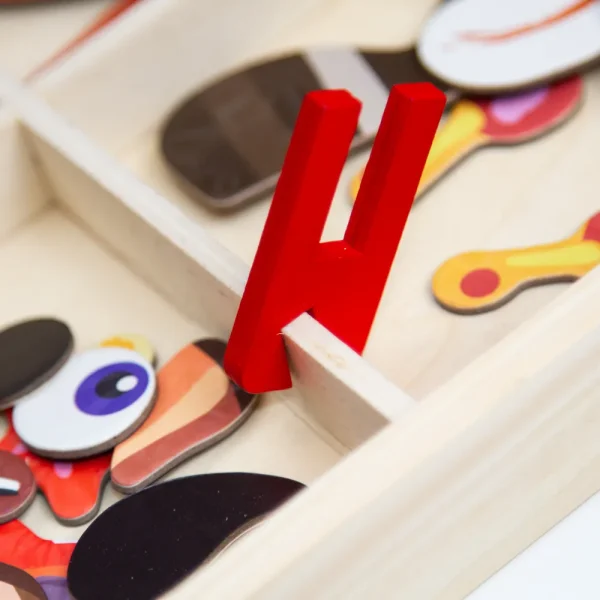
Supporting image: paper puzzle construction from the children's toys path — paper, printing and age grading all sit inside the toy documentation set.
AHA-CG Series — custom craft gifts & stationery
- Product types: sticky notes, pens, erasers, plus notebooks, stickers, bookmarks and desk accessories across the wider range.
- Material base: paper (coated, kraft, cardboard), plastic (PVC/PP), metal (iron/stainless steel).
- Size: fully customizable; standard paper sizes A5/A6/A7, and 76×76 mm or 100×100 mm for sticky notes.
- Material thickness: customizable — 80 g to 300 g for paper, 1.5 mm to 3 mm for plastic and metal.
- Printing methods: offset printing, screen printing, UV digital printing, embossing and debossing.
- Ink: eco-friendly water-based, non-toxic and fade-resistant.
- Packaging: OPP bag, colour box, gift box, blister pack.
- Stated compliance: EN71, REACH, RoHS — available upon request.
- Typical industries: promotional advertising, corporate gifting, education, stationery retail.
The stationery path gives a buyer more levers per unit: four print methods, a wide paper-weight band and four standard packaging formats. Those same levers are where budget variance comes from, which is why specification discipline matters more on this path than on toys.
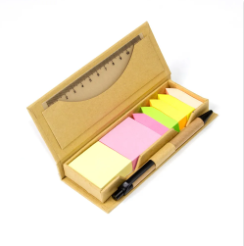
Supporting image: a printed sticky-note pad from the stationery path, where paper weight, print method and packaging format set both appearance and cost.
The shared manufacturing backbone
Both paths run through the same OEM/ODM operation, and that is where the comparison stops being purely product-level:
- Customization scope: logo, design, size, colour and packaging, with full-scale customization from product design through to final packaging.
- Engineering: a 5-engineer R&D team supporting design and technical development.
- Quality control: 100% inspection, applied as full-process inspection from raw material selection through production processing to finished product packaging.
- Capacity: 500,000 units per month, against annual output of 5,000,000 units.
- Lead time: 15–30 days.
- MOQ: 2,000 units as listed in AHA's capability data. Small trial orders and large bulk orders are both accepted, and the case record notes standard bulk orders at 10,000+ units with small orders negotiable — so the applicable MOQ should be confirmed at RFQ stage.
- After-sales: custom design revision support and an after-sales quality guarantee.
One documented programme shows how that backbone is used in practice. A US distributor and promotional agency has ordered customized promotional gifts, corporate souvenirs and retail merchandise on a basis proportional to order scale — 10,000+ units for standard bulk orders — for three years, with the relationship built around one-stop customization and a multi-category portfolio rather than a single SKU.
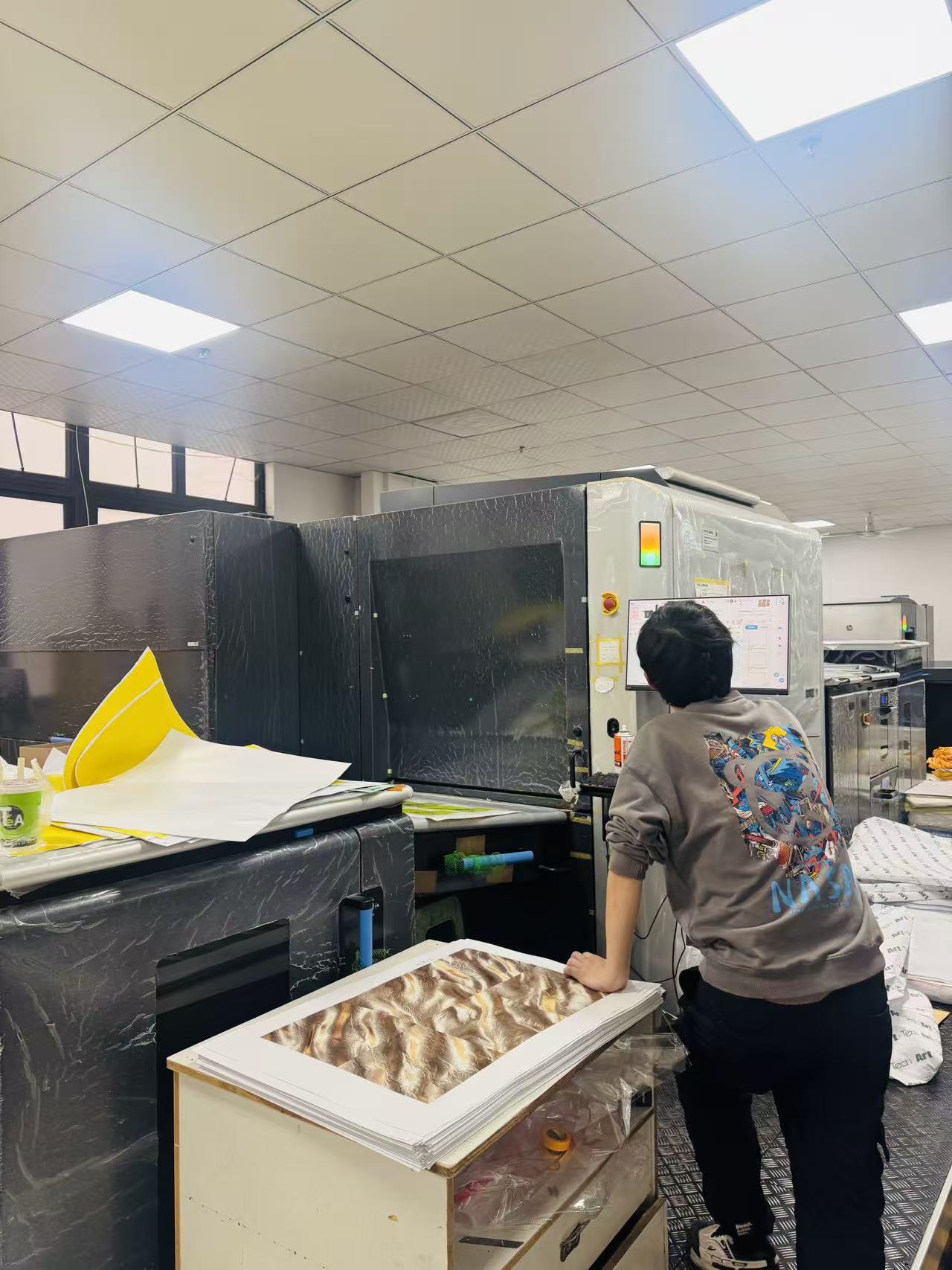
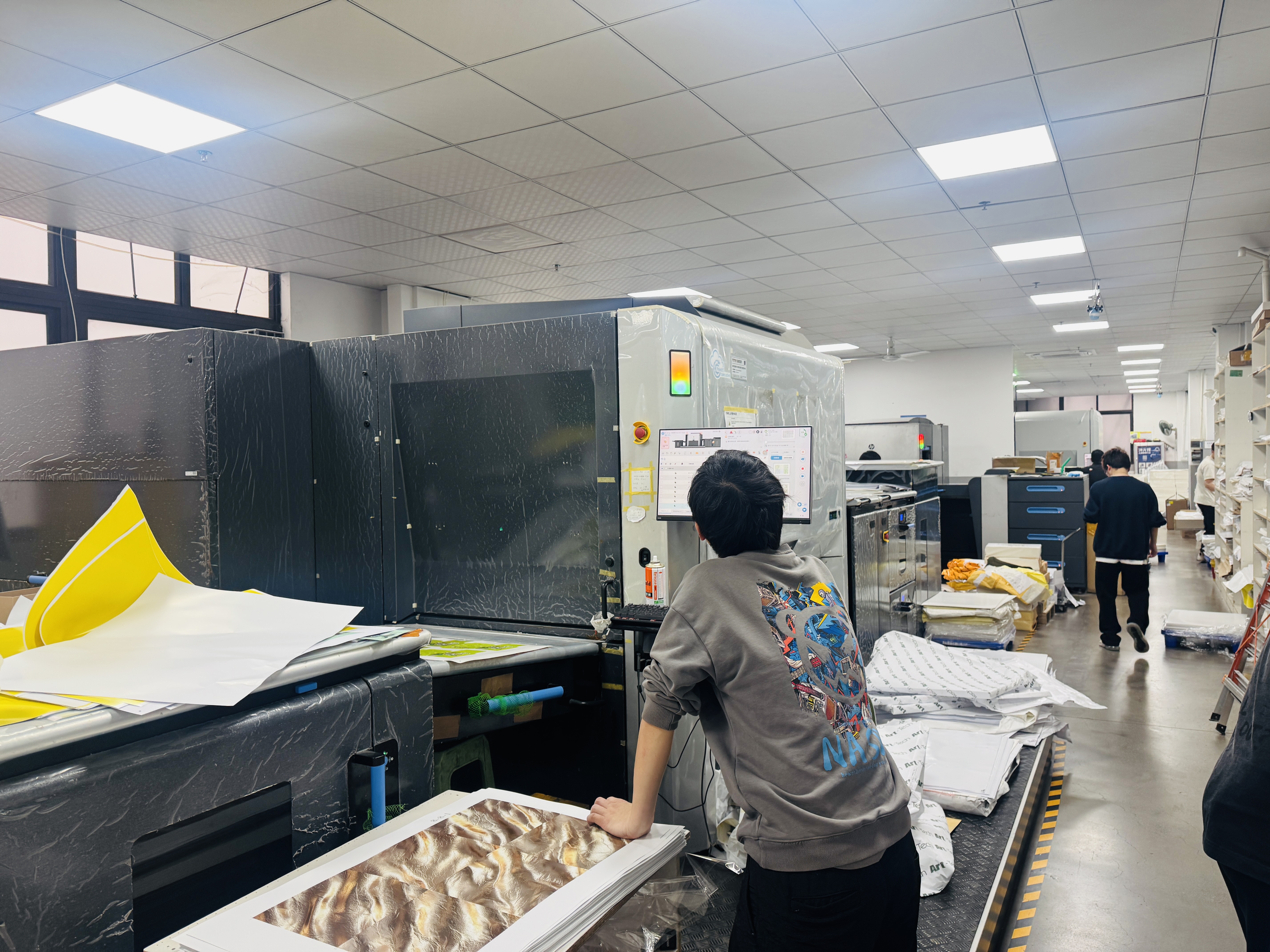
Proof image: AHA production workshop — the same full-process inspection flow is applied to both toy and stationery orders.
Step-by-Step Breakdown: a decision sequence for buyers
Step 1 — Classify by intended use and play value
Write down who the product is for and what they do with it. If a child plays with the item and it carries play value, plan it as a toy and confirm the classification case by case with the factory. Do this before design, because it fixes the test file that everything else depends on.
Step 2 — Lock the safety file before artwork
On the toys path, request the documentation attached to the specific SKU against the stated targets — ASTM F963, EN71, CPSIA, CE. On the stationery path, request EN71, REACH and RoHS as applicable, noting that AHA lists these as available upon request. Artwork approved before the file is agreed is artwork that may have to be redone.
Step 3 — Fix the material and decoration route
On toys, the material decision is also the compliance decision: food-grade plastic, paper, plush fabric or natural wood, all non-toxic and phthalate-free, printed with eco-friendly non-toxic ink. On stationery, the route is a performance and cost decision: paper weight between 80 g and 300 g, plastic or metal between 1.5 mm and 3 mm, and a print method chosen from offset, screen, UV digital, embossing or debossing.
Step 4 — Choose the packaging format
Packaging is fully customizable on both paths. On stationery the practical starting menu is OPP bag, colour box, gift box or blister pack, and the gift-box option is usually what decides whether the item reads as a giveaway or as a gift.
Step 5 — Size the order against MOQ and capacity
Match the programme to the 2,000-unit MOQ reference and to 500,000 units per month of capacity. Small trial quantities and bulk runs are both part of AHA's stated order model, which matters when a buyer is testing a new gift line before committing to annual volume.
Step 6 — Validate with a sample or trial order
Check material hand-feel, print registration, colour against the brand palette, packaging fit and — on the toys path — age grading and safety labelling. Custom design revision support exists precisely for this stage, and it is cheaper than reworking a bulk run.
Step 7 — Confirm lead time and document handover
Plan against a 15–30 day production lead time and add the time needed for artwork approval and document review. Where the EU is the destination market, resolve the regulatory-transition question before the launch date is announced rather than after.
Use Cases: where each path earns its place
Corporate gifting
Desk-adjacent stationery wins here — a printed notebook, a branded pen, a sticky-note set in a gift box — because it stays visible in an office and takes a logo cleanly across offset, screen or UV digital printing. Toys enter corporate gifting mainly as family-oriented seasonal items, where the safety file has to be planned in advance.
Retail and e-commerce
Both paths work, but the risk profile differs. Toys need age grading and safety documentation carried into the product listing; stationery needs accurate material and print specifications so the listing matches the shipment. A bulk pattern of 10,000+ units with small-order flexibility supports a test launch before scaling.
Education
Education is the segment where the two paths overlap most directly: DIY craft kits, paper puzzles and educational toys on one side, notebooks, stickers and bookmarks on the other. Classification — not product naming — is the deciding question when a school kit contains both.
Event giveaways
Giveaways favour the stationery path's cost levers — paper weight, print method and packaging format — while assembled children's craft kits shift the value proposition from unit cost to time spent engaging with the brand.
Promotional programmes
Programmes that need a mixed set — a kids' item plus a desk item — are the strongest argument for sourcing both paths from one OEM/ODM supplier, because design, packaging and shipment stay on a single schedule and a single inspection standard.
Comparison Table: children's toys vs. craft gifts & stationery
| Decision criterion | AHA-CT Series (children's toys & crafts) | AHA-CG Series (craft gifts & stationery) |
|---|---|---|
| Typical programmes | Toy retail lines, education kits, family-oriented gifting, assembled kids' craft kits | Corporate gifting, promotional giveaways, stationery retail, event programmes |
| Core materials | Food-grade plastic, paper, plush fabric, natural wood | Paper (coated/kraft/cardboard), plastic (PVC/PP), metal (iron/stainless steel) |
| Material property focus | Non-toxic, BPA-free, phthalate-free, food-grade | Paper 80–300 g; plastic/metal 1.5–3 mm thickness |
| Stated compliance targets | ASTM F963, EN71, CPSIA, CE | EN71, REACH, RoHS (available upon request) |
| Printing and decoration | Eco-friendly non-toxic ink, customizable | Offset, screen, UV digital, embossing/debossing; water-based non-toxic ink |
| Packaging | Fully customizable | OPP bag, colour box, gift box, blister pack |
| Age grading | 3+ years recommended, customizable | Not applicable to the standard product types |
| MOQ reference | 2,000 units (capability data) | 2,000 units (capability data) |
| Lead time | 15–30 days | 15–30 days |
| Main risk to manage | Product classification and toy-safety documentation | Drift between agreed and delivered print, material and packaging specifications |
| Best fit when | The item is played with, gifted to children, or sold into toy and education channels | The item is branded, desk-based, higher volume, or needs multiple print and packaging options |
Decision rules: choosing one path, or both
- Choose the toys path when the item will be played with by children, sold into toy or education channels, or given to families — and budget time for the safety file before design freeze.
- Choose the stationery path when logo visibility, print variety, packaging formats and per-unit cost control drive the programme.
- Split the brief, not the supplier when a programme needs both paths: one design process, one packaging standard, one inspection flow and one shipment.
- Never decide by product name alone. An arts-and-crafts kit with play value is assessed as a toy, case by case, regardless of how the purchase order labels it.
Frequently asked questions
What safety documentation should buyers request for each product path?
For the AHA-CT Series, AHA lists ASTM F963, EN71, CPSIA and CE as its compliance targets; request the documentation attached to the specific SKU. For the AHA-CG Series, AHA lists EN71, REACH and RoHS, available upon request. Because European Commission guidance treats an arts-and-crafts kit with play value as a toy, assessed case by case, a kids' craft kit may need the toy file rather than the stationery file. For EU placement, the framework summarised by EUR-Lex also calls for a safety assessment, technical documentation and CE marking.
Can one OEM/ODM supplier cover both product paths?
Yes. AHA's range spans children's toys and crafts (AHA-CT Series) and craft gifts and stationery (AHA-CG Series) alongside other gift categories. OEM/ODM customization covers logo, design, size, colour and packaging, with full-scale customization from design to final packaging supported by a 5-engineer R&D team. Capacity is 500,000 units per month against 5,000,000 units annually, quality control is 100% inspection, and lead time is 15–30 days.
What drives the budget difference between the two paths?
AHA's published product data does not list unit prices; quotations are prepared against a specification. Four things drive cost: material (food-grade plastic, plush or natural wood versus paper, PVC/PP or metal), decoration (non-toxic toy printing versus offset, screen, UV digital, embossing or debossing), packaging (fully customizable on toys; OPP bag, colour box, gift box or blister pack on stationery), and order quantity against the 2,000-unit MOQ reference. Safety documentation adds scope on the toy path that the stationery path does not carry.
How should a buyer validate a product before a bulk order?
Use the sample and trial-order route. AHA accepts small trial orders alongside large bulk orders and provides custom design revision support, so a buyer can check material, print registration, colour, packaging fit and — on the toy path — age grading and labelling before scaling. The case record notes standard bulk orders of 10,000+ units with small orders negotiable, which shows the range a programme can sit in.
What is the production lead time, and what can move it?
AHA's capability data lists a 15–30 day lead time with 500,000 units of monthly capacity behind it. In practice the schedule is set by what happens before production: artwork approval, first-time tooling where a design is new, packaging confirmation and document review on the toy path. Buyers working to a fixed launch date should confirm the sequence at quotation stage — a sample or quote request through AHA's contact channels is the fastest way to get dates against a real specification.
Conclusion
The head-to-head resolves into a simple rule. If a child plays with the product, plan it as a toy: classify it case by case, settle the safety file against ASTM F963, EN71, CPSIA or CE before artwork, and expect documentation to sit inside the lead time. If the product is a branded desk or decorative item, plan it as stationery: choose the paper weight or thickness, pick the print method, choose the packaging format and let those three variables carry the cost discussion.
Because AHA runs both paths through one OEM/ODM operation — 5-engineer R&D support, full-scale customization from design to packaging, 100% inspection, 500,000 units monthly capacity and a 15–30 day lead time — a mixed programme does not need a split supplier base. The decision is about which rulebook applies to which SKU, not about which factory to call.
Next step: request a sample or a quotation
Send the product path, target market, quantity, print method and packaging format. AHA's sales team replies with a professional quotation and can arrange a sample or a small trial order before a bulk run.
Website: www.ahacustomshop.com · Email: vera@ahagiftsch.com / duke@ahagiftsch.com · WhatsApp & Tel: +86 13958790933
Have Questions or Need More Details?
Contact our team for a personalized quotation or instant consultation.
Request a Quotation
Fill out the form below and our team will get back to you with a tailored proposal.
WhatsApp Direct Chat
Prefer to chat in real-time? Message us on WhatsApp for instant assistance & quick answers.
- Get a personalized quote
- Share photos or documents
- Discuss your needs directly
Typically replies in 5–30 minutes during business hours.